
TL;DR: Opening a Lithuanian bank or EMI account depends on residency, business activity, ownership, source of funds, and the institution’s requirements. Lithuanian residents generally have straightforward banking options, while non-residents and foreign companies may face additional due diligence. Traditional banks and EMIs offer different services, protections, and payment capabilities, making the right structure important.
Lithuania has become an important European banking and fintech jurisdiction for both residents and international businesses. As an EU and euro-area member, Lithuania provides access to SEPA payments, regulated banking services, and a growing electronic money institution (EMI) sector.
For Lithuanian residents, opening a traditional bank account is generally straightforward when standard identification and KYC requirements are met. For opening a Lithuania bank account for non-residents, and understanding how to open a bank account in Lithuania, foreign companies, the options are more varied. Depending on the applicant's profile, a traditional bank, Lithuanian-licensed EMI, or specialized financial institution may be appropriate, particularly for businesses looking to open an EU bank account.
The important distinction is that a Lithuanian bank account and an EMI account are not the same thing. They provide different services and have different customer-funds protection arrangements.
Related Reading: Establishing A Bussines In Hong Kong For Lithuania
Why Lithuania Matters for European Banking
Lithuania combines conventional banking with a well-developed fintech infrastructure.
Traditional banks provide services such as deposits, cards, lending, and other banking products. Alongside them, licensed EMIs and payment institutions serve international businesses that need European payment infrastructure without necessarily maintaining a traditional retail-bank relationship.
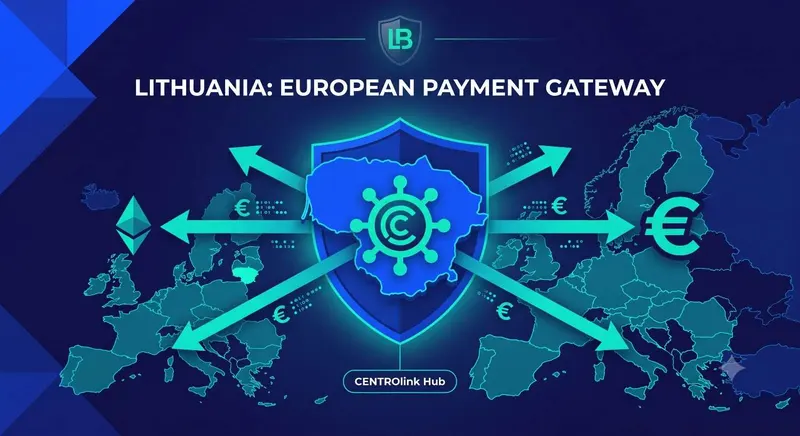
One of Lithuania's key advantages is CENTROlink, the payment system operated by the Bank of Lithuania. Eligible banks, electronic money institutions, and payment institutions can participate directly in CENTROlink, subject to the applicable requirements.
This infrastructure has helped Lithuania become an important location for businesses seeking European payment and SEPA capabilities.
What Is CENTROlink?
CENTROlink is the payment system operated by the Bank of Lithuania.
It allows eligible payment service providers, including banks, specialized banks, electronic money institutions, and payment institutions, to participate directly, subject to the relevant requirements. For businesses, this matters because a Lithuanian EMI with the appropriate access can provide European payment infrastructure and SEPA functionality without operating as a traditional bank. This makes Lithuania particularly relevant for companies whose main requirement is European payment access rather than lending or a full traditional banking relationship.
Who Can Open a Lithuanian Bank or EMI Account?
Eligibility depends on the institution and the applicant's circumstances.
| Applicant | Traditional bank | Lithuanian EMI |
|---|---|---|
| Lithuanian resident | Generally available | Available |
| EU/EEA resident | Case-by-case | Often available, subject to policy |
| Non-EU resident | More restricted | Case-by-case |
| Lithuanian company | Generally available | Available |
| Foreign company with genuine EU activity | Case-by-case | Potentially available |
| Offshore/shell structure | Highly restricted | Usually difficult |
Non-resident applicants should not assume that every Lithuanian institution will accept them. Banks and EMIs assess the customer's identity, business activity, source of funds, ownership structure, and expected transactions before approving an account.
What Documents Are Required?
The exact requirements vary between institutions, but applicants should be prepared to provide standard KYC or KYB documentation.
Personal Account
A personal applicant may need:
- Valid passport or national identity card
- Proof of residential address
- Rental agreement, utility bill or municipal registration
- Lithuanian personal code, where applicable
- Foreign tax identification number, where applicable
- Tax-residence information
- Employment contract, payslips or self-employment evidence
- Source-of-funds documentation for larger balances or higher-risk profiles
The address document will generally need to be recent and show the applicant's name.
Corporate Account
A Lithuanian or foreign company may need:
- Certificate of incorporation
- Articles of association or equivalent constitutional documents
- Current directors and shareholders register
- UBO declaration and supporting ownership documents
- Passport copies for directors, shareholders and UBOs
- Registered-office and operating-address evidence
- Business plan or description of the company's activities
- Commercial contracts, invoices or other evidence of trading
- Expected transaction volumes
- Source-of-funds documentation
For a non-EU company, additional legalisation or apostille requirements may apply depending on the documents and institution.
The central question for a corporate bank account in Lithuania application is not simply whether the company exists. The institution will want to understand what the company does, who controls it, where it operates, where its money comes from, and how the account will be used.
How to Open an Account in Lithuania
For applicants researching how to open a bank account in lithuania, the process depends on whether you choose a traditional bank or an EMI. The requirements for a lithuania bank account can vary depending on your residency, account type, and institution.
Traditional Bank
Traditional banks may require an in-person meeting, particularly for applicants without an established Lithuanian relationship.
The general process is:
- Select a bank based on your residence and banking requirements.
- Submit the initial application or contact the relevant banking team.
- Prepare identification, address, tax, and source-of-funds documents.
- Complete KYC and any required in-person identification.
- Wait for the bank's compliance review.
- Sign the account documentation and fund the account once approved.
Lithuanian EMI
A licensed EMI may provide a more remote-oriented process.
A typical application involves:
- Selecting a suitable Bank of Lithuania EMI account.
- Completing the online application.
- Uploading identification and supporting documents.
- Completing remote identity verification where supported.
- Answering compliance questions about the applicant or company.
- Receiving the account and IBAN after approval.
- Funding the account through an accepted payment route.
Remote onboarding is permitted within the EU regulatory framework, but financial institutions must use appropriate customer-identification and AML/CFT controls. The EBA's remote onboarding guidelines specifically establish requirements for safe and effective remote customer onboarding.
Remote onboarding does not eliminate customer due diligence requirements; institutions must still apply appropriate AML/CFT and customer-identification controls.
Bank vs. EMI: Which Is Different?
Understanding this distinction is essential when choosing a Lithuanian financial account.
| Feature | Traditional Bank | Lithuanian EMI |
|---|---|---|
| Regulatory model | Credit institution | Electronic money institution |
| Deposit guarantee | Eligible deposits generally protected up to €100,000 per depositor per bank | Not covered by bank DGS |
| Customer funds | Bank deposits | Safeguarded under applicable e-money rules |
| SEPA access | Yes | Yes, where the institution participates |
| CENTROLink | May participate | Eligible EMIs can participate directly |
| Remote onboarding | Depends on bank | Often available |
| Lending | Available depending on bank | Not equivalent to bank lending |
| Best suited to | Full banking relationship | Payments and cross-border business needs |
EU rules protect eligible bank deposits up to €100,000 per depositor per bank through deposit guarantee schemes.
Bank deposits covered by the applicable deposit-guarantee scheme are subject to deposit protection of up to €100,000. EMI customer funds are subject to a separate safeguarding framework and should not be presented as equivalent to insured bank deposits.
Can a Non-Resident Open an Account in Lithuania?
Potentially, yes.
Opening Lithuania bank accounts for non-residents generally faces more limited options at traditional retail banks, while some Lithuanian-licensed EMIs may onboard foreign individuals and companies remotely.
For foreign companies, the strength of the application often depends on the company's genuine commercial activity, ownership transparency, and connection to European business.
A company with clear operations, identifiable UBOs, documented revenue and legitimate European trading activity presents a different compliance profile from a structure created solely to obtain an IBAN.
Banking Fees & Account-Opening Timelines
| Banking Service / Process | 2026 Benchmark | Key Consideration |
|---|---|---|
| Retail personal account | €0–€10/month | Usually depends on the bank and account package |
| Retail business account | €10–€30/month | Pricing varies by business-account features |
| EMI business account | €0–€100/month | Often structured around different feature or transaction tiers |
| Outgoing SEPA transfer | €0–€1 | Standard transfers are generally low-cost |
| Outgoing SWIFT transfer | €10–€25 + correspondent fees | Additional charges may apply through intermediary banks |
| Retail-bank onboarding | 3–4 weeks | Timing depends on KYC and document verification |
| EMI onboarding | 3–15 business days | Can vary based on business profile and compliance checks |
Why Applications May Be Rejected
Lithuanian banks and EMIs must comply with AML/CFT and other regulatory requirements. Applications can therefore face problems where:
- The company's business activity is unclear.
- The UBO structure cannot be adequately verified.
- The source of funds is poorly documented.
- Expected transactions do not match the business model.
- The applicant has sanctions or PEP concerns.
- Adverse media creates additional compliance questions.
- The company has little or no demonstrable economic substance.
- The applicant's industry falls outside the institution's risk appetite.
High-risk sectors may require specialist providers or enhanced due diligence rather than a standard business account.
How Long Does It Take?
There is no single timeframe for Lithuania.
Traditional bank onboarding can take longer because of additional documentation and, in some cases, an in-person verification process. EMI onboarding can be faster when the application is straightforward, and the institution supports the applicant's profile.
The actual timeline depends on:
- Applicant residence
- Account type
- Business activity
- Ownership structure
- Completeness of documentation
- Compliance questions
- Institution-specific policies
For this reason, claims that every Lithuanian account can be opened within five minutes are misleading. Digital onboarding can make the process faster, but compliance review still determines the final timeline.
What Are the Main Benefits?
A Lithuanian banking or EMI relationship can provide several practical advantages for eligible applicants:
- Access to European financial infrastructure
- Euro-denominated accounts
- SEPA payment capabilities
- Potential remote onboarding through eligible EMIs
- European IBAN functionality
- Access to regulated banking or payment institutions
- Suitable options for cross-border businesses
However, the benefits depend on the type of institution selected. A company that needs credit facilities, lending, or a traditional deposit relationship may need a bank rather than an EMI.
Choosing the Right Lithuanian Banking Route
The right solution depends on what you actually need from the account.
- If you are a Lithuanian resident seeking everyday banking, a traditional bank may provide a broader range of services.
- If you are a foreign company primarily seeking European payment infrastructure, a regulated Lithuanian EMI may provide a more suitable route.
- If you need lending, credit facilities, or a traditional deposit relationship, an EMI should not automatically be treated as a substitute for a bank.
The important step is therefore to assess the applicant profile and banking requirements before selecting an institution.
Open a European Account with the Right Structure
Opening a Lithuanian bank or financial account is not simply a matter of submitting a passport and completing an online form. The appropriate route depends on residence, business activity, ownership, source of funds, and the services the applicant actually requires.
Note: Regulatory and banking information reviewed in September 2026. Financial-institution policies, onboarding requirements, and product availability can change and should be verified before an application is submitted.
Supporting research links
Wikipedia
- List of Banks in Lithuania - Wikipedia
- Bank of Lithuania - Wikipedia
- Can I open a bank account as non-resident? - Reddit
Image gallery


No published comments yet.