

Summary
Hong Kong company registration is a streamlined process, with straightforward private companies limited by shares capable of being incorporated electronically very quickly. This guide explains the key steps, statutory costs, requirements, and ongoing obligations for founders establishing a Hong Kong company, including non-resident entrepreneurs.
Hong Kong can be attractive for international businesses because of its established legal and financial infrastructure, access to Asian markets, and territorial basis of Profits Tax. However, tax treatment depends on the company's actual activities and circumstances rather than simply where the company is incorporated.
How do you register a company in Hong Kong?
To register a company in Hong Kong, choose a company name, prepare Form NNC1 and the Articles of Association, appoint a Hong Kong company secretary, provide a Hong Kong registered office address, and file the application with the Companies Registry, online or on paper. Business registration is handled in the same filing. Electronic applications for private companies limited by shares are normally approved within 1 hour, and the government charges total HK$3,895 for online filing.
Key Highlights
- A private company limited by shares needs at least 1 shareholder, 1 natural-person director, a company secretary and a Hong Kong registered office.
- No Hong Kong resident director and no minimum paid-up capital are required.
- Government charges for online registration total HK$3,895 (HK$1,545 incorporation fee plus HK$2,350 Business Registration for 2026/27).
- Electronic certificates are normally issued within 1 hour; hard-copy applications within 4 working days.
- After registration, the company must file an Annual Return, renew its Business Registration, keep accounts and have them audited each year.
Why Founders Choose Hong Kong Company Registration
Hong Kong is an established international business and financial hub on account of its geographical location, legal framework, financial structure, and its nearby Asia-Pacific region.
Organizations carrying out cross-border activities like international trade, purchasing, E-commerce, etc., have found the relevance of Hong Kong through these factors.
Some of the main reasons why founders choose Hong Kong company incorporation include:
- Territorial basis of Profits Tax: In general, Hong Kong taxes profits generated or sourced from Hong Kong. Whether certain profits qualify for offshore treatment depends on their specific facts and circumstances and the applicable tax rules.
- Foreign ownership is permitted: Non-residents can generally own shares in a Hong Kong company.
- Non-resident directors are permitted: There is no general requirement for a director of a Hong Kong private company to be a Hong Kong resident.
- Remote incorporation is possible: Applications for company incorporation can be submitted online via the e-Services Portal of the Companies Registry.
- Gateway to China and Asia-Pacific regions: A business that wishes to trade and expand in the region will find Hong Kong to be an effective base of operations.
- Established financial system: Hong Kong has a developed banking and professional services ecosystem that helps international firms.
For international entrepreneurs, the importance of Hong Kong thus extends beyond just the fast track to incorporation. The company structure needs to be taken into account along with taxation, banking, compliance, substance, and future growth considerations.
Who Is Hong Kong Company Registration Suitable For?
Hong Kong company registration can be relevant for international founders who want to establish a business presence in Asia, conduct cross-border trade, work with international customers or suppliers, or use Hong Kong as part of a broader regional business structure.
It may be relevant for:
- International trading and sourcing businesses
- E-commerce businesses serving Asian or international markets
- Consulting and professional services businesses
- Technology and SaaS companies with international customers
- Businesses using Hong Kong for regional operations
- Investment or holding structures where appropriate
- Entrepreneurs who require access to Hong Kong's established banking and professional services ecosystem
However, Hong Kong company incorporation should not be based only on the jurisdiction's reputation, tax system, or ease of registration. The proposed business activity, ownership structure, customers, suppliers, expected transactions, banking requirements, tax position, compliance obligations, and long-term expansion plans should all be considered before choosing the structure.
For international founders, this assessment can be particularly important where company formation will later be followed by a Hong Kong bank account, payment solutions, accounting, tax, or cross-border banking requirements.
Who Can Register a Company in Hong Kong?
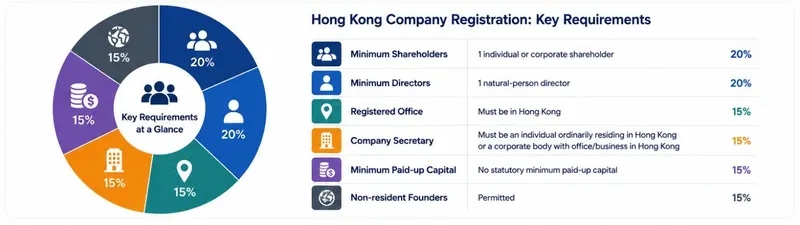
For a typical private company limited by shares, the basic requirements include:
| Requirement | Details |
|---|---|
| Minimum shareholders | 1 individual or corporate shareholder |
| Minimum directors | 1 natural-person director |
| Local director required | No |
| Company secretary | Yes |
| Company secretary: individual | Must ordinarily reside in Hong Kong |
| Company secretary: body corporate | Must have its registered office or a place of business in Hong Kong |
| Registered office | Yes. The registered office must be in Hong Kong |
| Minimum paid-up capital | No statutory minimum paid-up capital |
| Non-resident founders | Permitted, subject to the applicable incorporation and compliance requirements |
A private company having only one director cannot appoint that sole director as its company secretary.
What Is the Difference Between Hong Kong Company Registration, Incorporation and Formation?
Hong Kong company registration, incorporation, and company formation are closely related terms used when establishing a business, but they can refer to different parts of the setup process.
- Company incorporation: The legal process of creating a company as a separate legal entity through the Hong Kong Companies Registry.
- Company registration: Generally refers to completing the required registration process for the company.
- Company formation: A broader term that can include incorporation as well as setting up the company secretary, registered office, and other business requirements.
- In practice: The terms are often used interchangeably when discussing the process of establishing a Hong Kong company.
- For international founders: Company formation may also involve banking, accounting, tax, payment solutions, and ongoing compliance planning.
What Business Activities Can a Hong Kong Company Conduct?
A Hong Kong company can generally conduct a wide range of lawful commercial activities. However, the appropriate structure and any required licences, permits, or approvals depend on the nature of the business.
Founders should clearly define the intended business activity during the incorporation and planning stage, particularly where the company will operate in a regulated sector.
Depending on the business model, additional considerations may apply to activities involving:
- Financial services
- Insurance
- Payment services
- Money service activities
- Securities or investment activities
- Certain professional services
- Import and export activities
- Other regulated commercial activities
Incorporating a company does not by itself give the company permission to conduct a regulated activity. Where a licence, permit, or regulatory approval is required, the relevant requirements should be assessed separately.
For international founders, understanding the intended activity before incorporation can also help ensure that the proposed ownership structure, banking profile, payment requirements, and compliance arrangements are aligned with the actual business.
How to Register a Company in Hong Kong
Step 1: Select a Company Name
Before submitting the incorporation application, choose an appropriate company name.
For a Hong Kong private company limited by shares:
- The English company name generally ends with Limited.
- A Chinese company name can also be adopted.
- The name should comply with Hong Kong's company-name requirements and should not be the same as, or otherwise prohibited by the applicable rules relating to, an existing registered company name.
- There might be certain words and expressions that need the approval of the Registrar beforehand or may be subject to particular regulatory requirements.
The Companies Registry will only confirm if the proposed company name is acceptable for registration when the incorporation application is processed. A name search before incorporation therefore reduces risk but does not itself guarantee registration.
Step 2: Prepare the Incorporation Documents
For a private company limited by shares, the incorporation application generally includes:
- Form NNC1: Incorporation Form
- Articles of Association
- IRBR1: Notice to Business Registration Office
- Required information and declarations relating to the founder member, directors, company secretary, registered office and shareholding structure.
Where applicable, a director's consent to act must also be provided. The Companies Registry states that other first directors may deliver Form NNC3, Consent to Act as First Director, within the prescribed period after incorporation.
For non-resident founders, identification and supporting documents will also be required. Certification requirements can vary depending on the documents and the circumstances of the application.
Documents Required From International Founders
Depending on the founder, shareholder structure, and incorporation circumstances, international applicants may be asked to provide identification and supporting information for directors, shareholders, and beneficial owners.
This may include:
- Passport or other acceptable identification
- Residential address information
- Proof of address where required
- Information about the proposed business activity
- Shareholding and ownership information
- Details of beneficial owners where applicable
- Source of funds or source of wealth information where relevant
- Supporting information about the business, customers, suppliers, or expected transactions where required
The exact documentation depends on the circumstances of the application and the requirements of the relevant service provider or financial institution.
For founders who intend to apply for a Hong Kong bank account, additional due diligence information may be requested by the bank or financial institution. Incorporation documents alone do not guarantee approval of a corporate banking application.
Step 3: Appoint a Company Secretary
Every Hong Kong company must have a company secretary.
The company secretary must be either:
- An individual who ordinarily resides in Hong Kong, or
- A body corporate whose registered office or place of business is in Hong Kong.
Where company secretarial services are provided in the course of business, applicable Trust or Company Service Provider (TCSP) licensing requirements should also be considered.
The company secretary has an important ongoing role in maintaining corporate records and supporting the company with statutory compliance.
For an international founder without an appropriate Hong Kong-based secretary, a professional corporate services provider may be able to provide the required company-secretarial support.
Step 4: Designate a Registered Office Address
Every Hong Kong company must have a registered office in Hong Kong from incorporation.
The registered office:
- Must be situated in Hong Kong.
- Is the company's official registered address.
- Is used for receiving statutory and official correspondence.
- Must be provided in the incorporation application.
A founder does not necessarily need to lease a separate commercial office solely for incorporation. A suitable registered office service may be used where appropriate, subject to the provider's services and the company's requirements.
Step 5: Submit the Incorporation Application
The incorporation application can be submitted electronically through the Companies Registry's e-Services Portal or in hard-copy form.
Electronic applications:
Incorporation fee: HKD 1,545
Straightforward private companies limited by shares can normally be incorporated electronically very quickly when the proposed name does not require further consideration, and the application passes the system validation.
Hard-copy applications:
Incorporation fee: HKD 1,720
Straightforward applications are generally processed within the applicable Companies Registry processing timeframe.
From the Companies Registry, e-incorporation is optional, while applications can also be submitted in hard copy.
After approval of the application, the Companies Registry will then issue a certificate of incorporation. For an electronic application, the certificates can be downloaded electronically.
How Long Does Hong Kong Company Registration Take?
| Stage | Typical timeframe |
|---|---|
| Electronic incorporation (e-Services Portal) | Certificate normally issued within 1 hour for private companies limited by shares |
| Hard-copy incorporation | Certificate normally issued within 4 working days |
| Business Registration Certificate | Issued together with the Certificate of Incorporation through the one-stop filing |
| Corporate bank account | Usually several weeks, depending on the bank and your compliance profile |
This makes registration company Hong Kong remote filing realistic for non-resident founders, since the whole incorporation can be completed online without visiting Hong Kong.
Official source: Companies Registry – Register a company
Step 6: Obtain the Business Registration Certificate
A newly incorporated Hong Kong company is also subject to business registration.
For the current 2026/27 period, the one-year Business Registration charge is HKD 2,350 in total, comprising:
- Business Registration Fee: HKD 2,200
- Business Registration Levy: HKD 150
- Total: HKD 2,350
The Business Registration application is integrated with the incorporation process for a company incorporated under the Companies Ordinance. The applicable Business Registration Fee and Levy should be checked when planning future renewals because government charges can change.
Hong Kong Company Registration Number and Company Search
Your company’s identifiers appear on its certificates. Since 27 December 2023, the Companies Registry has used the Unique Business Identifier (UBI), which is the first 8 digits of the Business Registration number, as the main company identifier. Companies incorporated before that date also keep their original Company Registration (CR) number.
To run a Hong Kong company registration search, use the Companies Registry’s Cyber Search Centre. You can check a company’s name, registration status and filed documents, which is useful for verifying suppliers, customers or your own records. about the certificate itself in our guide to the Hong Kong Certificate of Incorporation.
Step 7: Open a Corporate Bank Account
Company incorporation is only the beginning. Banking should be considered as part of the structure from the outset.
The most suitable banking solution depends on the company's activities, ownership, transaction flows, jurisdictions involved, expected turnover, counterparties, and compliance profile.
Depending on the business model, founders may consider:
- Traditional bank accounts for companies requiring established banking relationships, broader services, trade finance, or more complex corporate facilities.
- EMI and virtual business accounts where appropriate for remote onboarding, multi-currency balances, payments, and international transfers.
- International banking solutions where the company's activities and compliance profile make them appropriate.
Banking is subject to each institution's independent due diligence and approval process. Incorporation of a Hong Kong company does not guarantee approval for any particular bank or financial institution.
For this reason, banking requirements are best considered before incorporation rather than treated as an entirely separate step afterwards.
For founders planning to open a Hong Kong bank account, the company's proposed business activity, ownership structure, expected transaction flows, source of funds, customers, suppliers, and supporting documents should be consistent with the proposed banking profile.
Hong Kong Company Registration Cost Breakdown
It is important to distinguish official government charges from professional and service-provider costs.
A. Official Government Charges
The cost of setting up a company in Hong Kong depends on both official government charges and the professional services required. The overall Hong Kong company setup cost may include incorporation fees, Business Registration charges, company secretary services, a registered office address, incorporation assistance, banking guidance, and ongoing compliance support. The final cost therefore varies depending on the company's structure and the services selected.
| Item | Current Amount |
|---|---|
| Companies Registry incorporation fee: electronic filing | HKD 1,545 |
| Companies Registry incorporation fee: hard-copy filing | HKD 1,720 |
| Business Registration Fee: 1 year | HKD 2,200 |
| Business Registration Levy | HKD 150 |
| Business Registration charge: 1 year total | HKD 2,350 |
| Total government charges: online incorporation | HKD 3,895 |
The HKD 3,895 online total comprises:
HKD 1,545 incorporation fee + HKD 2,200 Business Registration Fee + HKD 150 levy.
The hard-copy incorporation route has a higher Companies Registry incorporation fee of HKD 1,720 before the applicable Business Registration charge.
B. Professional and Service-Provider Costs
These costs are not fixed government charges and vary according to the provider and scope of work.
| Service | Cost |
|---|---|
| Company secretary service | Varies by provider and service scope |
| Registered office address service | Varies by provider and service scope |
| Incorporation and advisory support | Varies by provider and service scope |
| Banking guidance or assistance | Varies by provider and scope |
| Ongoing compliance and advisory | Varies by provider and service scope |
There is therefore no single official total first-year company formation cost beyond the applicable statutory charges. A founder's actual first-year expenditure will depend on the professional services and banking support selected.
Annual Compliance Requirements After Registration
Registering the company is only the beginning. A Hong Kong company must continue to meet its statutory and tax obligations.
Depending on the company's circumstances, ongoing requirements can include:
- Filing the Annual Return (Form NAR1) with the Companies Registry within the applicable statutory deadline.
- Renewing the Business Registration Certificate and paying the applicable Business Registration Fee and Levy.
- Filing Profits Tax Returns when required by the Inland Revenue Department.
- Maintaining proper accounting records and preparing financial statements.
- Obtaining an audit where required under Hong Kong's applicable requirements.
- Maintaining a company secretary and a Hong Kong registered office.
- Keeping statutory registers and corporate information up to date.
- Maintaining appropriate records to support the company's tax position and business activities.
Key deadlines and audit: A private company files its Annual Return within 42 days after each anniversary of incorporation. The first Profits Tax Return is normally issued about 18 months after incorporation. Every Hong Kong limited company must have its financial statements audited each year, unless it is a dormant company. See our guide to accounting services in Hong Kong for details.
Official source: IRD – Profits Tax
Companies carrying on business internationally should also keep clear documentation of their actual activities, functions, contracts, decision-making, customers, suppliers, and other relevant facts. Where a company seeks offshore treatment for particular profits, the tax position depends on the actual facts and applicable Hong Kong tax rules; incorporation in Hong Kong alone does not automatically make profits offshore.
Failure to meet statutory or tax obligations can result in penalties and other consequences.
Significant Controllers Register
For international founders, maintaining accurate ownership and control information is also an important part of ongoing corporate compliance.
Where applicable, the company should maintain its Significant Controllers Register (SCR) and keep relevant information about significant controllers up to date.
This is particularly relevant where the company has international shareholders or beneficial owners and maintains banking, payment, or cross-border business relationships.
Overseas Company Registration in Hong Kong (Non-Hong Kong Companies)
If you already own a company incorporated outside Hong Kong, such as a BVI, UK or US company, you have two options. You can incorporate a new Hong Kong subsidiary, or register the existing company as a registered non-Hong Kong company. A non-Hong Kong company that establishes a place of business in Hong Kong must apply for registration with Form NN1 within one month after establishing that place of business. The electronic application fee is HK$1,545, and Business Registration is payable separately.
A subsidiary is usually simpler for banking and tax purposes, while registering the existing company suits groups that want one legal entity. Our cost calculator can help you compare setup costs.
Official source: Companies Registry – Registered non-Hong Kong companies
What to Do After Registering a Hong Kong Company
Registering the company is only the first stage of establishing a functioning international business structure.
After incorporation, founders may need to:
- Obtain and securely retain the Certificate of Incorporation and Business Registration Certificate.
- Establish a suitable Hong Kong bank account or alternative business banking arrangement.
- Set up accounting and bookkeeping processes.
- Confirm the company's tax and filing obligations.
- Maintain the company secretary and Hong Kong registered office.
- Maintain statutory registers and corporate information.
- Review any licences or regulatory approvals relevant to the business activity.
- Establish appropriate payment arrangements.
- Maintain documentation supporting the company's actual business activities and transactions.
- Prepare for annual filings and other ongoing compliance requirements.
For international founders, these matters should ideally be considered before incorporation because the intended banking, tax, payment, and compliance setup can influence the appropriate company structure.
Is Hong Kong the Right Jurisdiction for Your Business?
Hong Kong is not necessarily the best jurisdiction for every international business. The appropriate choice depends on factors such as:
- Business activity
- Target markets
- Ownership structure
- Banking requirements
- Tax considerations
- Regulatory requirements
- Payment requirements
- Substance and operational needs
- Long-term expansion plans
For some businesses, Hong Kong may be appropriate because of its position in Asia and its established financial infrastructure. For others, another jurisdiction may provide a better fit.
International founders should therefore assess the jurisdiction together with the intended corporate, banking, tax, payment, and compliance structure before incorporating.
This is particularly important where the founder expects to open a Hong Kong bank account, work with international payment providers, receive funds from multiple jurisdictions, or expand into other Asian markets.
The approach begins with understanding the client's business model, ownership, banking objectives, tax considerations, and long-term expansion plans before recommending an appropriate structure.
Support can include:
- Company formation strategy based on the proposed business activity
- Preparation and review of incorporation documentation
- Company secretary and registered office arrangements
- Banking readiness and documentation guidance
- Introductions to banking and EMI partners where appropriate
- Support with corporate banking applications
- Ongoing compliance and advisory support
Licensing disclosure: Company secretary and registered office services are provided through our licensed partner, Corpagent Online (HK) Limited (TCSP Licence No. TC007194).
For international founders, incorporation is only one part of establishing a sustainable cross-border structure. The corporate setup should also work with the company's banking, tax, compliance, payment, and expansion requirements.
Remote incorporation would help make Hong Kong available to non-resident entrepreneurs without having to relocate to Hong Kong. The actual procedure and accompanying paperwork would vary depending on who the founder is, the ownership model, the business, and the service provider(s.
Planning to Register a Company in Hong Kong?
If you are an international founder considering Hong Kong company registration, the right structure should be assessed before incorporation, particularly if you also require a Hong Kong bank account, payment solutions, tax planning, or ongoing compliance support.
The appropriate setup depends on your business activity, ownership, target markets, banking requirements, and long-term plans. Discussing these requirements before incorporation can help ensure that the company structure is aligned with the way the business intends to operate.
External Sources
- Companies Registry – Register a company
- Companies Registry – e-Services Portal
- Companies Registry – Cyber Search Centre
- Companies Registry – Registered non-Hong Kong companies FAQ
- Inland Revenue Department – Profits Tax
Image gallery



No published comments yet.