
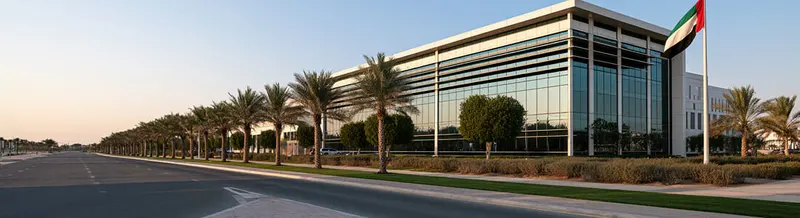
Company setup in Dubai Investment Park (DIP) suits traders and manufacturers as well as logistics operators and service providers. DIP is a large mixed-use development in southern Dubai with a total area of about 23 million square metres. It lies between Emirates Road and Sheikh Zayed Road, the two principal highways of Dubai, with Jebel Ali Port and Al Maktoum International Airport close by.
Before filing for registration, a business has to select premises and sign a lease for them. Next comes the licence for the chosen activity, along with any approvals that the type of business and the premises call for.
Why entrepreneurs locate their companies in DIP
The official name is Dubai Investments Park, and management lies with DIP Holding and its subsidiary Dubai Investments Park Development Company LLC. A single master plan brings different lines of business together on one site. Industry and logistics account for most of the park, at 78% of the leased area. Residential communities make up 14% and commercial real estate 8%, the latter consisting of offices, retail space and hotels.
Company registration in Dubai Investment Park is primarily suited to trading and customer-facing operations. Equipment suppliers and distributors can locate here, as can firms servicing industrial plants. These businesses value a convenient office, space to store goods and a location close to their partners and customers. Warehousing with suitable storage conditions is available in DIP. Inside the park a company can also receive and dispatch goods, work with carriers and organise its core operations.
What distinguishes DIP is access to long-term leases of land plots. The park operator holds a 99-year head lease, while tenants take sub-leases running for up to 30 years, as each agreement provides.
Who benefits from company registration in Dubai Investment Park
Firms for which logistics, storage or manufacturing is an important or core activity look closely at DIP. It suits importers and distributors that plan to build a full-scale supply chain. An enterprise that regularly brings in products from Asia or Europe, stores them in Dubai and then distributes them to customers across the region is better served by its own warehouse than by a fresh search for third-party space each time. Company setup in Dubai Investment Park makes sense where supply volumes are stable and the cost of storing and handling goods already weighs on the company's economics.
Manufacturers that have to install equipment and run production inside the UAE form another category. Such manufacturers have reason to consider business setup in Dubai Investment Park when a facility has to match specific production needs. Before committing, a manufacturer has to confirm three points: that its equipment can be installed, that the chosen activity is allowed and that the particular unit may be used for it. Industrial floor space in DIP does not in itself mean that every type of production can go ahead without further approvals.
DIP also appeals to suppliers of industrial equipment, building materials and other products that are inconvenient to store in an ordinary office. A DIP base lets a company combine its administrative function with storage and order picking.
Wholesale companies that handle large consignments and plan to grow a regional business from the UAE also have reason to look at the park. However, a dedicated facility turns into an unnecessary expense where products sit in the warehouse for long periods, orders arrive irregularly and sales are still small. In that situation it is worth comparing a DIP base with third-party warehousing and other options.
How company registration in Dubai Investment Park proceeds
The planned activity must be settled first. It fixes the licence type and what the premises must offer, as well as whether extra permits are needed and the costs involved. Several lines of activity are available in DIP.
- Trading and import-export. Buying, selling and supplying goods, including dealings with foreign suppliers and customers.
- Logistics and warehousing. Product storage, delivery arrangements and other permitted logistics operations.
- Manufacturing. Production of goods, assembly of equipment, processing of raw materials and other industrial processes.
- Professional services. Consulting, management and other work that falls inside the approved licence categories.
Where a company intends at the same time to import equipment, keep it in a warehouse and sell it to other businesses, this combination of operations needs the licensing authority's approval.
The next stage of company registration in Dubai Investment Park is the choice of legal form. That form determines who can own the company, how relations between its shareholders are formalised and which documents will be required.
- FZE (Free Zone Establishment) Set up by one founder under free zone rules.
- FZCO (Free Zone Company)The traditional choice under free zone rules when ownership is split between several founders.
- BranchFor a company already incorporated outside the UAE that plans to conduct permitted activities through a local office.
Not every tenant in DIP can use the FZE or FZCO form. That depends on the jurisdiction and the licensing authority in charge of incorporation. On the Invest in Dubai portal, mainland companies and free zone entities appear as separate categories. The portal places industrial parks, DIP included, within the infrastructure of the mainland jurisdiction. Licences fall into professional, commercial and industrial categories, and the principal authority granting them is the Dubai Department of Economy and Tourism (DET).
|
Mainland company |
Free zone company |
|
|
Who registers the company |
DET |
The relevant free zone authority |
|
Market access |
Clients throughout the UAE plus international business |
Clients abroad; direct trading on the mainland can require extra permits |
|
Foreign ownership |
100% permitted in many sectors, with restrictions for strategic activities |
100% foreign ownership |
|
Office requirements |
Normally a leased registered office, its minimum size fixed by activity type and licensing authority |
Options range from a virtual office or coworking desk to a separate office |
|
Visa allocation |
Linked to the activity, office area and regulators' rules, with the option to request a larger quota |
Linked to the registration package, office type and zone rules, sometimes with room to increase |
October 2025 brought the Free Zone Mainland Operating Permit, announced by the Dubai authorities as a special permit regime that opens mainland activity to companies registered in free zones. To apply, the company has to be a Dubai Unified Licence (DUL) holder and meet the eligibility criteria; applications are submitted electronically on the Invest in Dubai system.
Once activity and legal form are settled, incorporation proper gets under way. Its steps vary by jurisdiction and include initial approval, trade name registration and drafting of the constitutional documents, then address confirmation and licence issue.
A proposed name has to meet the naming rules of the licensing authority concerned and must not clash with existing registrations. Certain words, designations or proper names need extra clearance. Preparing several fallback names before filing is advisable, since it saves time if the first choice turns out to be unavailable.
At the outset the authority expects:
- passport copies for founders and authorised representatives;
- particulars of directors and shareholders;
- applicants' contact information;
- ownership structure;
- outline of the planned activity;
- the parent company's papers when a branch is registered;
- power of attorney where a representative files the documents.
Regulators may additionally ask for a photograph, visa or UAE entry details, evidence of address, more corporate records or a business plan. Where a shareholder is a legal entity, its incorporation and constitutional documents are also required, together with details of its directors and proof of its representative's authority. Whether translation, notarisation or legalisation applies depends on where the papers were issued and what the receiving authority demands.
Signing the lease comes before the licence, because the licensing authority requires a confirmed business address. Three main types of property are available.
- Ready-built warehouseSuited to storing products, picking orders and arranging shipments. Points to check include access for freight vehicles, ceiling height, loading and unloading facilities, ventilation and the storage conditions for specific goods.
- Industrial unit Considered for assembly, processing, equipment installation and other production processes. Here electrical capacity, utility connections, ventilation, permitted floor load and the safe operation of machinery all matter.
- Plot of land for construction Suited to a company that needs a building with bespoke specifications. This option requires an assessment of the permitted use of the plot, design approvals, construction costs and the time needed to bring the building into service.
Before the lease is signed, three questions need answers.
- Whether the chosen activity is permitted in the specific property.
- Whether the designated use of the premises meets the licensing requirements.
- Which costs the agreement provides for on top of the base rent.
It is necessary to ask the landlord and the park's operator in advance which documents and approvals a given unit needs. In some cases a NOC (No Objection Certificate) from the relevant body may be required. The Ejari registration procedure for the lease is another point to verify.
A company cannot operate properly without banking arrangements. Each bank runs its own review of an account application, weighing internal policy, what the firm does and the outcome of a risk assessment before reaching a decision. A typical package contains the following:
- a licence in force for the company's activity in DIP;
- incorporation papers and constitutional documents;
- founders' and signatories' passports;
- ultimate beneficial owner data;
- a summary of how the business works and the planned transactions;
- the countries the company expects to trade with;
- lease agreement or other proof of address;
- projected turnover, origin of funds and counterparties.
Banks may additionally seek supplier contracts and a business plan, together with evidence of the origin of funds and other papers showing how payments and business operations will be organised.
Taxation in DIP: can a company pay 0%?
For business setup in the UAE, tax treatment comes first when entrepreneurs compare possible locations. DIP is an industrial and business park where companies registered in a whole range of jurisdictions carry out their operations. A DIP address alone does not entitle a company to the incentives that free zones offer, as there is no separate Dubai Investment Park free zone with its own jurisdiction.
Under the general UAE regime, the first AED 375,000 of a company's taxable income is subject to a zero corporate tax rate, and the portion above that threshold attracts 9%. The standard rate of VAT stands at 5%. A business generally must register for VAT when the taxable supplies and imports it has made over the past 12 months add up to more than AED 375,000, or when it expects to exceed that sum over the next 30 days.
What opening a company in DIP costs
Several variables drive the cost of company registration in Dubai Investment Park: legal form and activity, licence and premises requirements, and the number of residence visas. A budget has to include distinct groups of expenses.
- Registration and licensingFees payable to the state vary by legal form and activity, by any extra approvals and by the procedure applicable.
- Premises rental Rent for an office, warehouse or production unit reflects floor area, condition, technical specification and contract terms.
- Residence visas Where the owner and staff plan to reside in the UAE, the budget must allow for permits, medical screening, Emirates ID and related formalities.
Conclusion
Dubai Investment Park (DIP) is the choice of entrepreneurs who intend to build a trading, logistics or manufacturing business in the UAE and the surrounding region. The park's infrastructure lets one business combine storage of goods and cargo handling with its dealings with suppliers and customers.
Choosing DIP means taking into account the legal framework a company there will operate under, the rules for using the premises and customs formalities. Before starting work, a company planning several lines of activity should obtain approval for all the operations it intends to carry out.
Our company's business consultants help with company setup in Dubai Investment Park: choosing a suitable legal form, obtaining the licence, arranging visas and opening a bank account. We review lease agreements, advise on statutory requirements and help reduce legal risks when a business is launched and run in DIP.
Frequently asked questions
What kinds of business does DIP accommodate?
DIP is a fit for trading and import-export, warehouse logistics and manufacturing, and for some professional services.
What does company registration in DIP cost?
The total reflects the legal form and licence, office or warehouse rent, the visa count and any extra permits. A sound cost estimate for company registration in Dubai Investment Park covers both the initial payments and the yearly renewal of licence and lease.
Is a warehouse lease in DIP compulsory?
That depends on how the business operates and on what the chosen activity requires. A trading or service company may manage with an office where its licence conditions allow it. Storage or manufacturing calls for premises matched to the operations and to their technical demands.
Can a DIP company import goods and sell them within the UAE?
Legal status, the licence held and the applicable trade and customs rules determine the answer. Handling imported goods means customs registration, declarations and, for some categories, permits. Free zone companies face additional requirements when operating on the mainland.

No published comments yet.